Choosing a handleless kitchen is not a trivial decision. It is a way of saying that the surface takes precedence, that the continuity of the front matters more than any fitting. Behind that apparent simplicity, however, lies considerable craft: each opening system has its own logic, its own feel, its own constraints that must be anticipated from the very first sketch.
What defines this kind of kitchen is not the absence of an object but the presence of an intention. The goal is a clean volume, a front that reads as a single plane, without breaks of light or details that catch the eye. We have been designing these projects in the workshop for many years. Here is what we have learned about the different solutions and how to choose between them.
The groove rail: the elegance of the recess
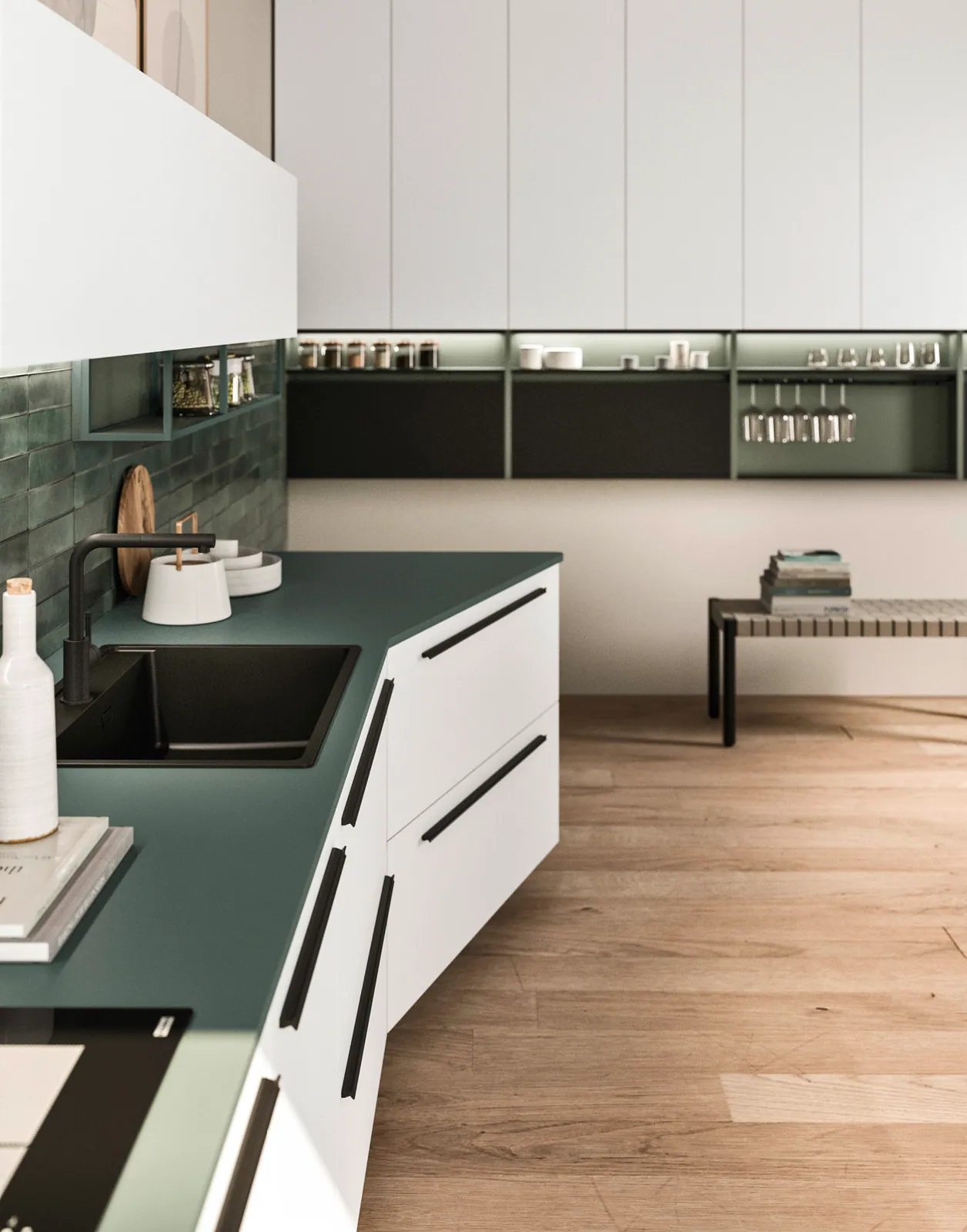
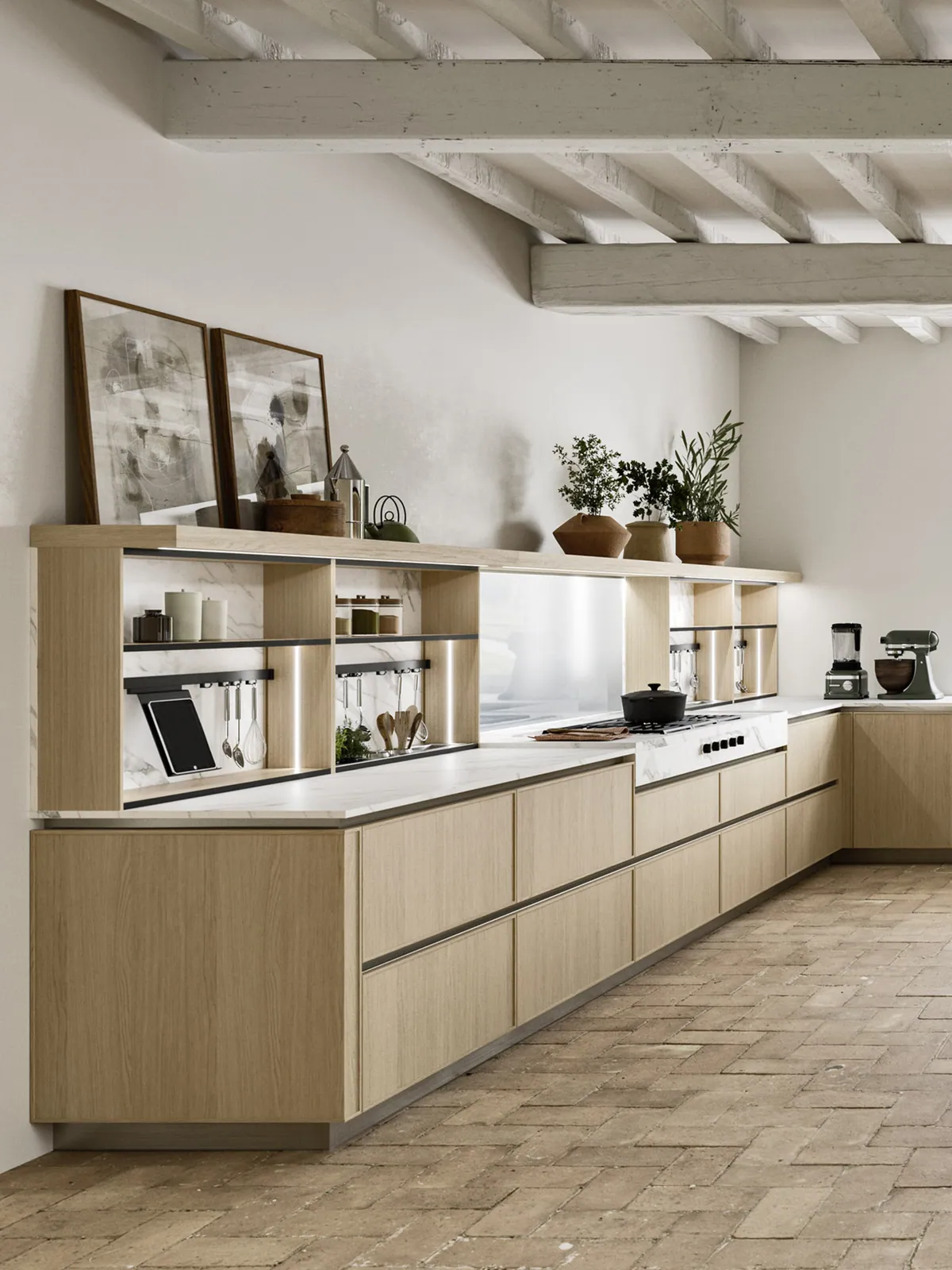
The groove rail is the most widespread solution, and often the most coherent. It is a routed channel along the top of each door or drawer front, allowing the hand to slide underneath naturally to pull the unit open. The groove can be milled in the same material as the front, in anodised aluminium, or in a contrasting wood, creating a horizontal line that runs the full length of the run. That line is not a detail: thoughtfully done, it becomes the rhythm of the kitchen, the equivalent of a continuous plinth that structures the whole.
The groove rail works on almost any front. It performs just as well on matte lacquer as on solid wood or veneer. The only technical constraint is the minimum height of the cabinet body: a very low drawer does not leave enough room to mill a comfortable recess. This is a dimension we plan for from the start, adjusting cabinet heights where needed.
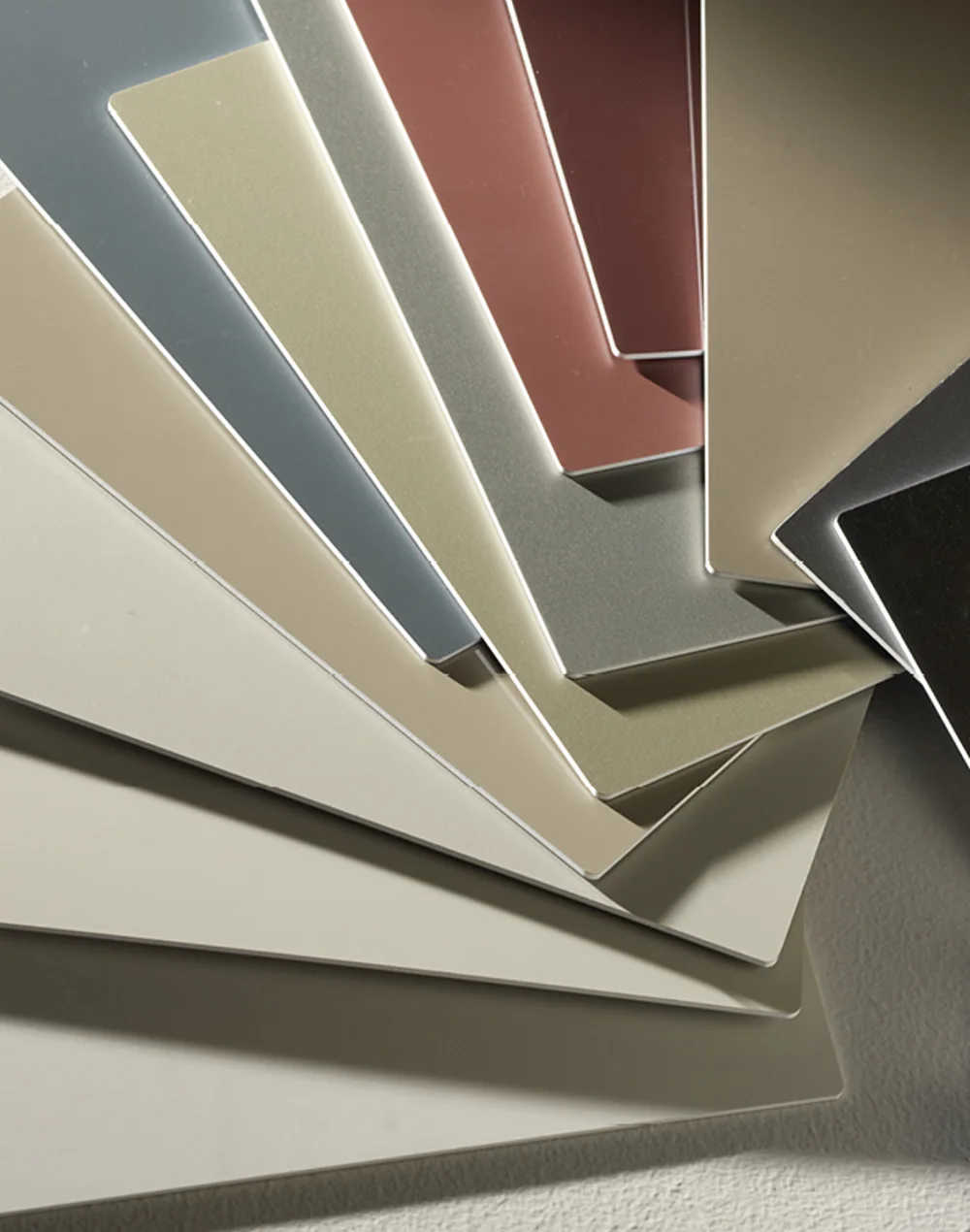
« Without a handle, every front is an unbroken surface. The kitchen stops being a piece of furniture and becomes a volume in the room. »
Push-to-open: opening by pressure
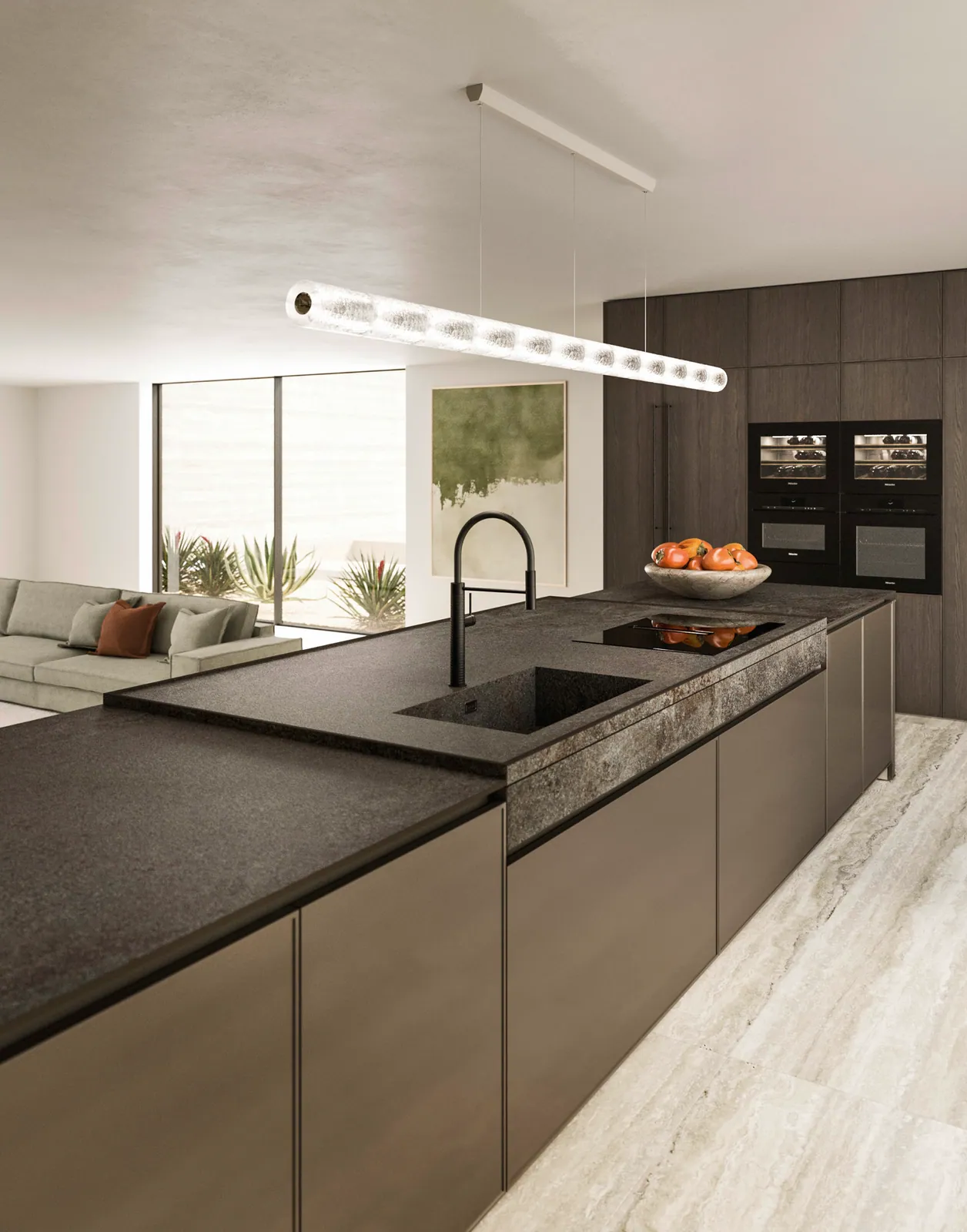
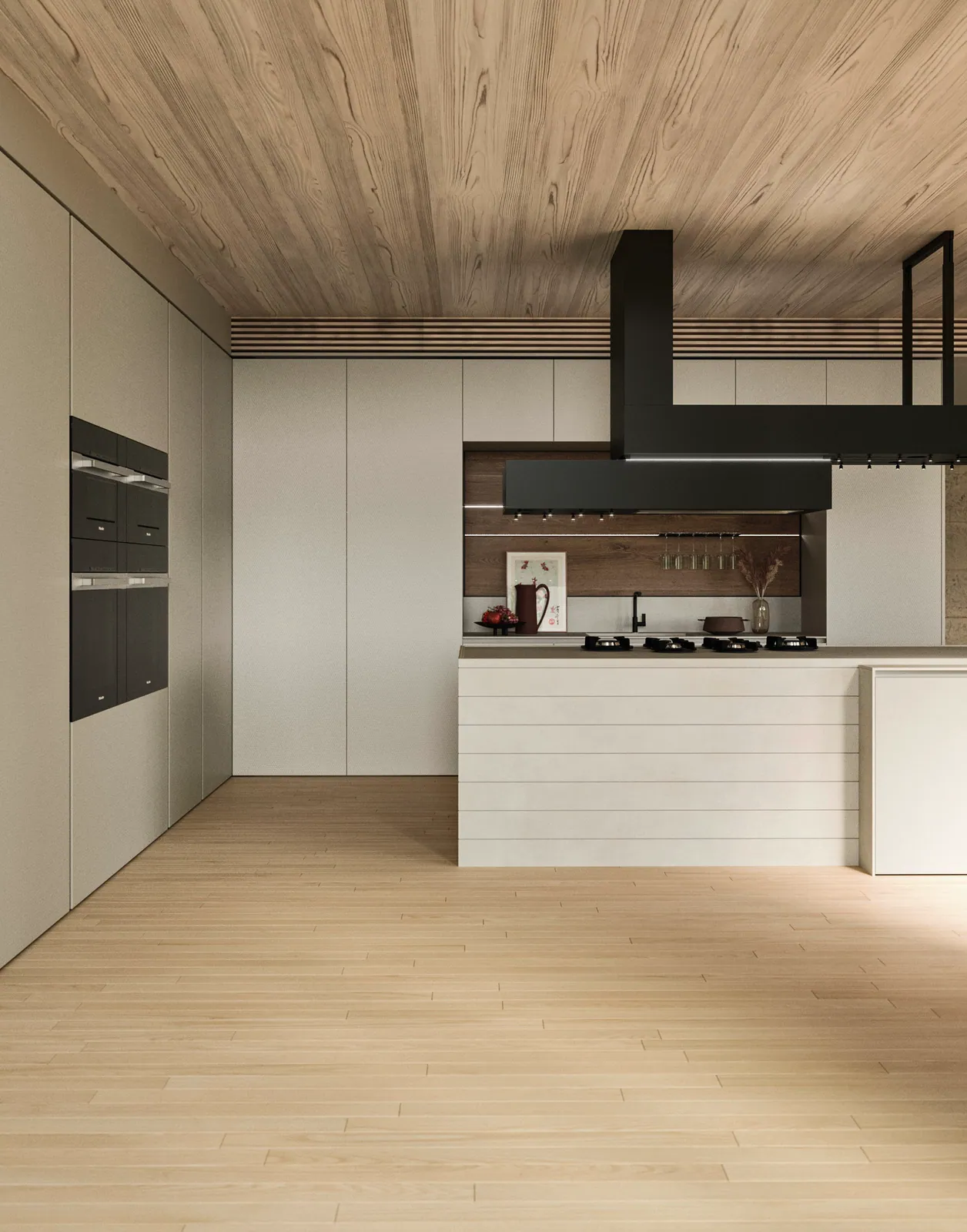
The push-to-open system works by impulse: press lightly on the front, a spring mechanism pushes it outward, and the door swings open. The main advantage is aesthetic: the front is entirely smooth, with no channel to interrupt the read. It is the choice that goes furthest in purity, producing a perfectly flat volume.
But push-to-open has its requirements. It calls for excellent damper quality: a low-grade mechanism bounces, claps shut and wears out quickly. We always specify systems with integrated soft-close damping, which stop silently and without a jolt. Placement in the kitchen also matters. A tall larder unit in push-to-open, opened with a light press, is ideal. A central drawer that you occasionally graze while setting down a plate can become a source of irritation. The position of each element in the layout therefore influences which system to use.
Push-to-open pairs naturally with matte or satin lacquer. On a strongly textured wood, it tends to feel less intuitive: timber calls more readily for a coordinated groove that highlights the material rather than erasing it.
The recessed plinth: the detail that structures
Less familiar than the groove, the recessed plinth is an architectural solution: the bottom of the cabinet body steps back a few centimetres behind the plane of the fronts, naturally freeing space to slide fingers underneath and open drawers and doors. The visual effect is striking. The kitchen appears to float lightly above the floor, as though suspended. This solution suits long linear runs and islands especially well, where the continuity of the front is paramount.
What these systems share
Groove rail, push-to-open or recessed plinth: all these solutions share one fundamental requirement, and that is the quality of the hardware. On a kitchen with handles, the fittings are discreet but visible. On a handleless kitchen, everything is hidden, which is precisely why quality must be beyond reproach. A damper that claps or a poorly milled groove will be noticed immediately, because there is nothing else to divert the eye or the ear.
These choices also have implications for maintenance. The groove rail can gather crumbs and fingerprints in the channel: a regular wipe with a lightly damp cloth is all it takes, but it must be a habit. Push-to-open has no crevices, making it easier to wipe down, provided the mechanism stays well adjusted over the years.
- The groove rail suits almost any front, gives a natural grip and introduces a horizontal line that paces the volume.
- Push-to-open produces the smoothest front, but demands quality mechanisms and careful thought about where each element sits.
- The recessed plinth is an architectural solution that visually lifts the furniture and suits long, continuous runs.
In practice, we often combine systems within the same kitchen: a groove rail on tall columns and doors, push-to-open on the drawers in the working zone. The key is that visual consistency is maintained and every choice is justified by how the kitchen will be used.
Thinking handleless from the first sketch
The choice of opening system is not a decision made at the end of the process. It conditions cabinet heights, front thicknesses, the position of under-cabinet lighting and sometimes even the type of hinge used. A handleless kitchen is conceived as a whole, from the first drawing to the day of installation. That is why we address this question at the very first meeting, before materials and colours have even been decided.
Coming to feel the fronts in the Beersel showroom, sensing the resistance of push-to-open, sliding your fingers into an aluminium groove rail: nothing replaces that direct contact when it comes to making an informed choice. Photographs give you the look; the showroom gives you the experience.