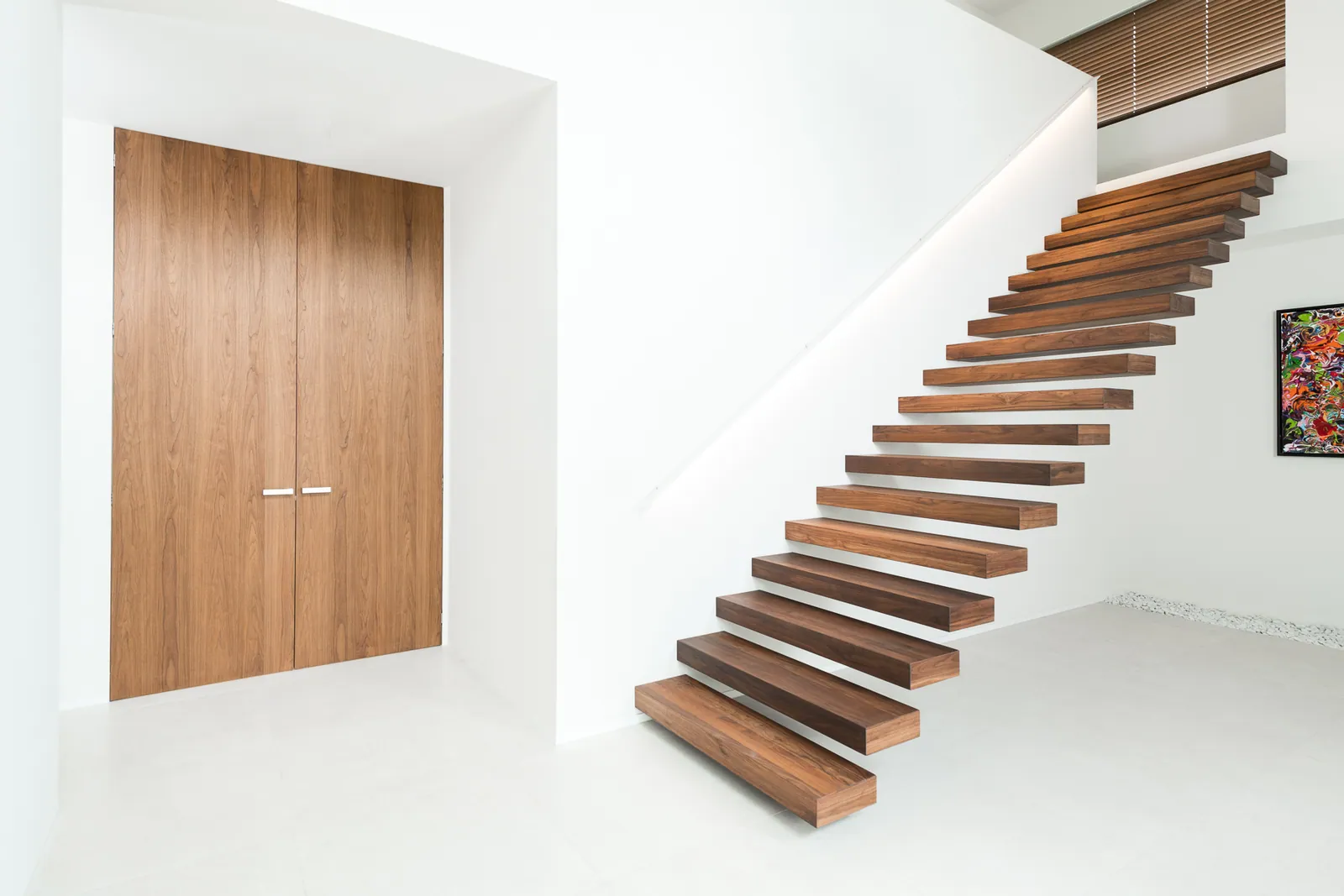
A floating staircase gives the impression that the steps hold themselves up. That is precisely the intended effect, and it is also the most demanding to achieve. What cannot be seen carries all the rest.
When you come across a staircase with floating steps, the eye looks for support and finds none. No heavy stringer along the side, no legs rising from the floor, sometimes not even a riser. This absence is deliberate. It frees the light, lightens the room and lets the gaze pass through. But a solid oak step carries its weight, and someone treading on it adds more. All that force has to go somewhere. The answer lies in a concealed structure, calculated step by step.
What really carries, beneath the apparent lightness
Two families of solutions recur in the workshops, both in wood. The first embeds the steps into the load-bearing wall, using anchor plates and rods sunk into the masonry, then entirely clad in wood: the staircase then seems to grow out of the wall. The second rests on a solid wood stringer concealed beneath the axis of the steps, onto which each one is fixed. In both cases, the fixing disappears once the work is complete. All you see is the step.
Rigidity therefore does not come from the thickness of the wood alone, but from the quality of the anchors and the way the loads travel back to the load-bearing wall. A well-designed floating staircase does not flex and does not vibrate, because each fixing point has been sized to take the real load, with a comfortable margin. This invisible work is the true subject.
« The lightness of a floating staircase is won in what is not shown. The step is beautiful, but it is the anchor that holds the beauty up. »
Materials chosen for the hand as much as for the eye
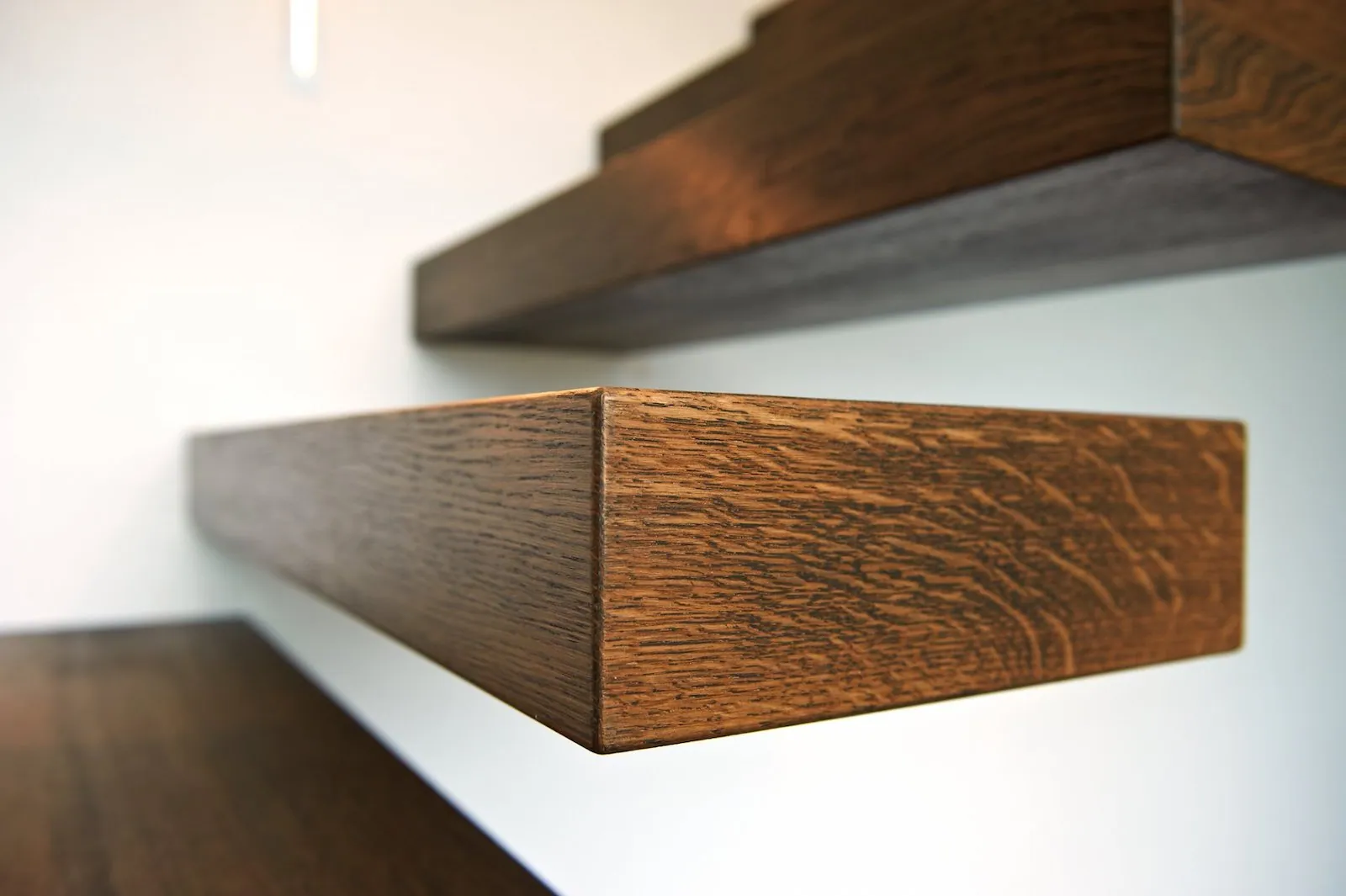
The wood of the step is the first contact, under the hand on the rail and under the foot with every stride. We work oak and walnut in solid form, for their resilience over time and their grain that patinates rather than wears out. The staircase, steps and stringer alike, always remains in wood. Glass and steel come in only for the railing, never to carry the staircase: glass for transparency and the continuity of the gaze, steel for the handrail and its fixings.
This distribution is not only aesthetic. The wood makes the staircase and gives it its warmth. At the railing, glass closes the void without weighing it down, which matters a great deal in a stairwell open to the sitting room, while steel absorbs the lateral thrust without flinching. To each material its role, for a single balance.
Comfort and safety, which are not up for negotiation
A floating staircase remains a staircase you use every day, often with your hands full, sometimes in the dark. Comfort is decided in the right proportions, verified from the study stage onward.
- The riser height and the going. The ratio between the height of each step and its depth defines the rhythm of the climb. Well set, you do not notice it. Badly set, you trip or run out of breath.
- The span study. Each cantilevered step is calculated according to its length, its thickness and the expected load. It is this study that guarantees the absence of any noticeable flex underfoot.
- The railing. Height, spacing of the elements and resistance to thrust meet the applicable standards, in particular when children live in the house. The transparency of glass exempts you from nothing.
- Quietness in use. A good floating staircase does not creak and does not knock. That quietness comes from anchors tightened without play and from careful installation, not from a miracle product.
The finish, last step and first contact
Once the structure is fitted and the steps fixed, the wood receives its protection. We favour hardened oil, which penetrates the fibre, lets the grain breathe and is simply revived over time. The step keeps its wooden touch rather than disappearing under a film. It is this detail, at the end, that turns a technical feat into a staircase you want to live with. This balance between strength and material is something we take the time to show you in Beersel, step in hand, rather than on a screen.