A bespoke staircase is one of the few elements in a home that you touch twice every day, for as long as you live there. The wood you choose, you watch it change with the seasons: it oils in, it builds a patina, it tells the story of the house. That decision deserves time: it commits you for the long term, and there is no universally correct answer, only the answer that fits your use, your light and your budget.
In the workshop we work with three species: oak as our reference, walnut for projects that seek a darker warmth, and rubberwood as our accessible option. Each has its own qualities, its real constraints and its relationship to ageing. Here is what you need to know before you decide.
Oak, our reference timber
Oak is the species with which we build the large majority of our staircases. That is not convention or conservatism: it is a technical choice grounded in decades of observation. Oak is hard, stable and little prone to seasonal movement in a well-heated Belgian interior. Its Janka hardness rating places it among the European timbers that bear decades of daily foot traffic without complaint.
Its grain is also what makes it a living material. Oak sawn flat reveals its medullary rays as golden moires; quarter-sawn, it gives a more discreet, regular, architectural figure. We choose the cut to suit the project: contemporary staircases with clean lines suit quarter-sawn better, while a warmer interior can accommodate the richness of flat-sawn oak.
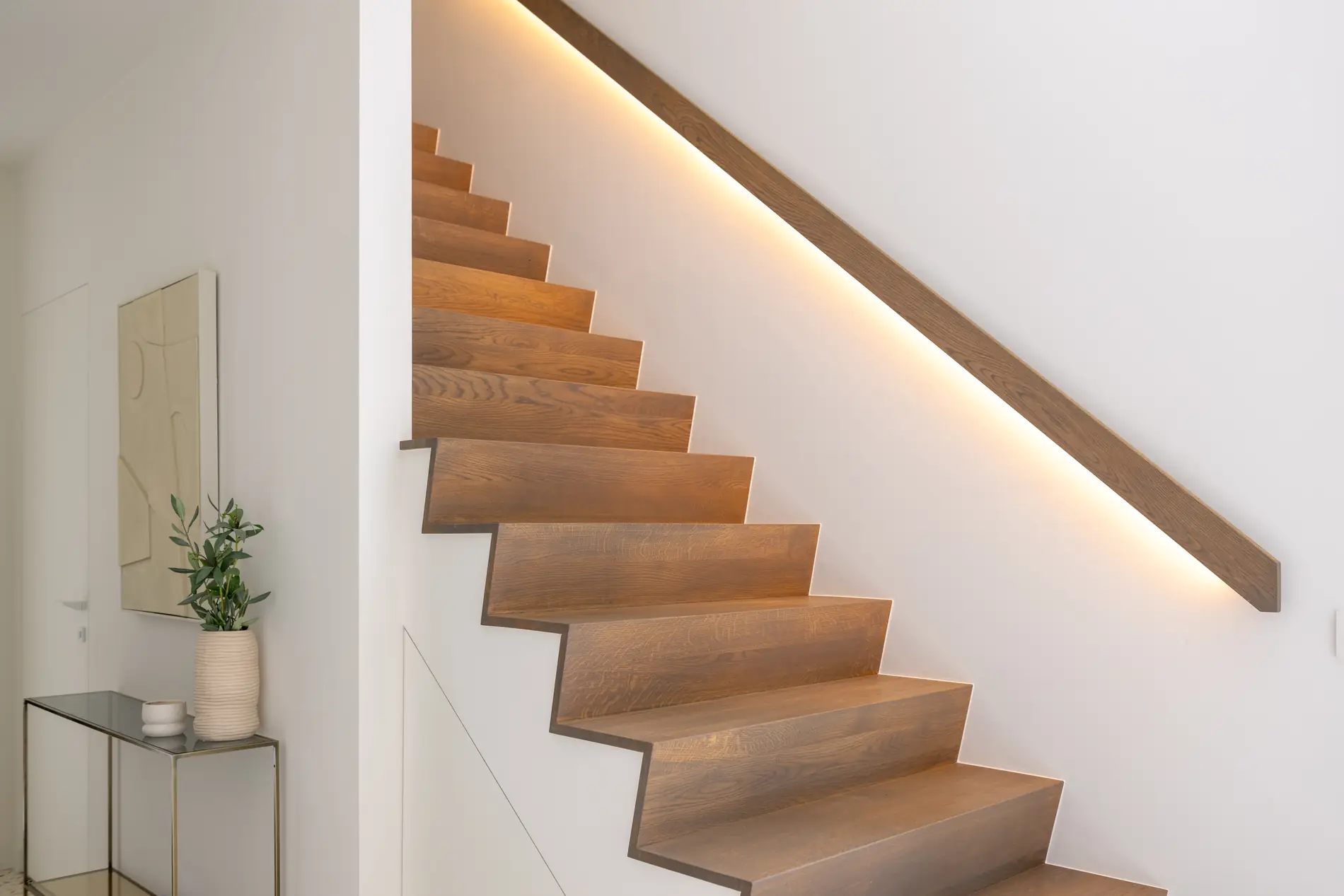
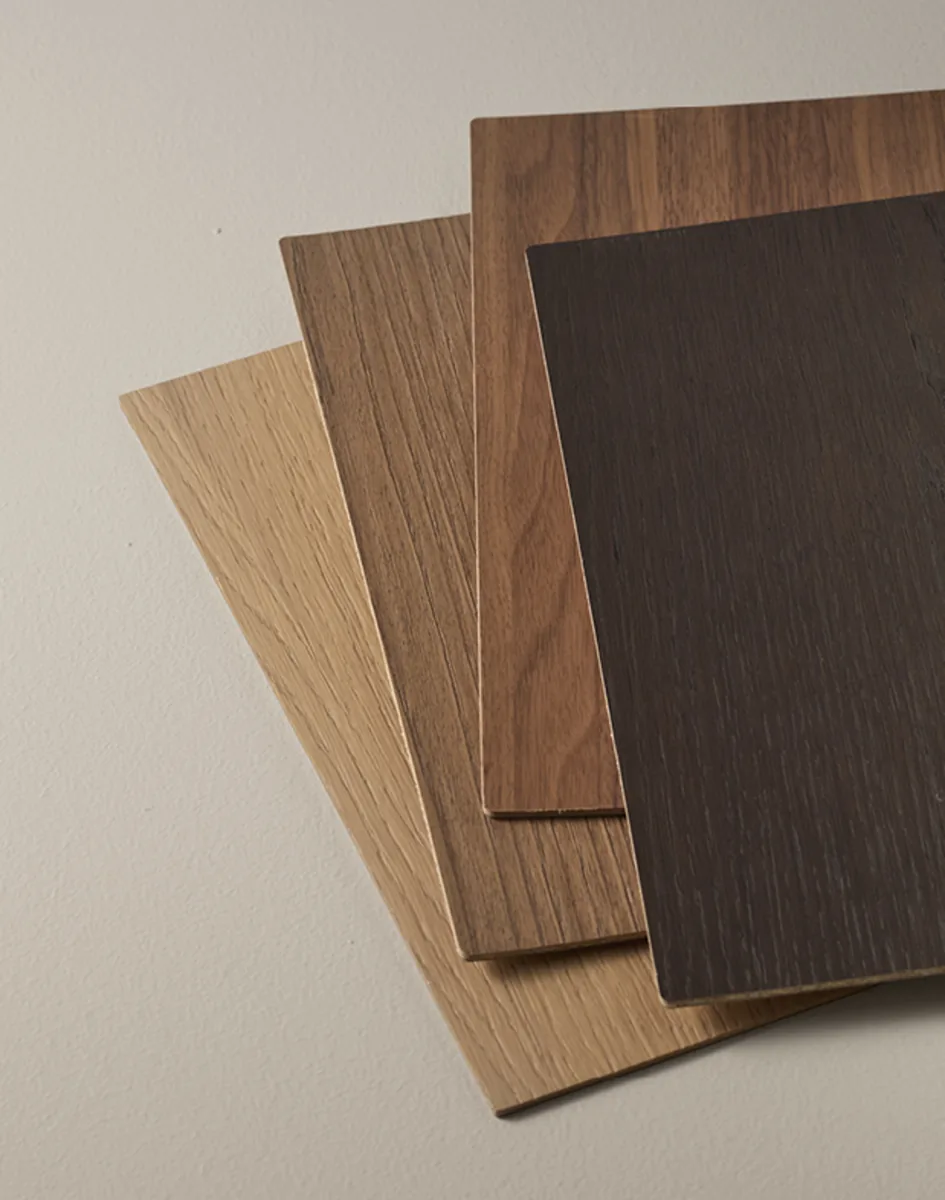
Oil is the finish we most often recommend on oak. It feeds the fibre, protects without building a surface film and allows local repair if a deep scratch appears. The colour can range from almost white natural to very dark smoked oak, depending on the pigmented oil chosen. A well-maintained oiled oak tread grows more beautiful over time: that is the promise of a noble material.
Walnut, for projects that want a darker warmth
Walnut is not in our standing range: we work with it on request, for projects that want something more singular. Its warm brown with violet undertones is immediately recognisable. Where oak can efface itself to let the rest of the interior speak, walnut asserts its presence. A walnut staircase becomes a piece of furniture in the fullest sense: something that matters in the room.
Its hardness is comparable to oak, slightly lower by specification but perfectly adequate for heavy residential use. Its stability is good. What sets it apart above all is its relationship to light: in a hallway that catches the morning sun, walnut changes face as the hours pass, showing copper veins in the morning and deepening towards evening. That quality appeals to some clients immediately and unsettles others. Better to see it in person at the showroom before committing.
Walnut is finished with oil or hardwax depending on the look sought. We advise against thick lacquer on this species: it would conceal precisely what makes walnut remarkable. A natural oil or hard wax is enough to protect the tread while preserving the depth of the grain.
Rubberwood, when budget steers the choice
Rubberwood, the timber of the rubber tree, is a species most clients do not know before they visit us. It deserves an honest explanation: it is our solution for projects where the budget sets the direction without the client wanting to sacrifice the quality of the joinery and the finish. Rubber tree timber comes from rubber plantations: when a tree stops producing latex, its wood is used rather than burned. It is a naturally sustainable chain.
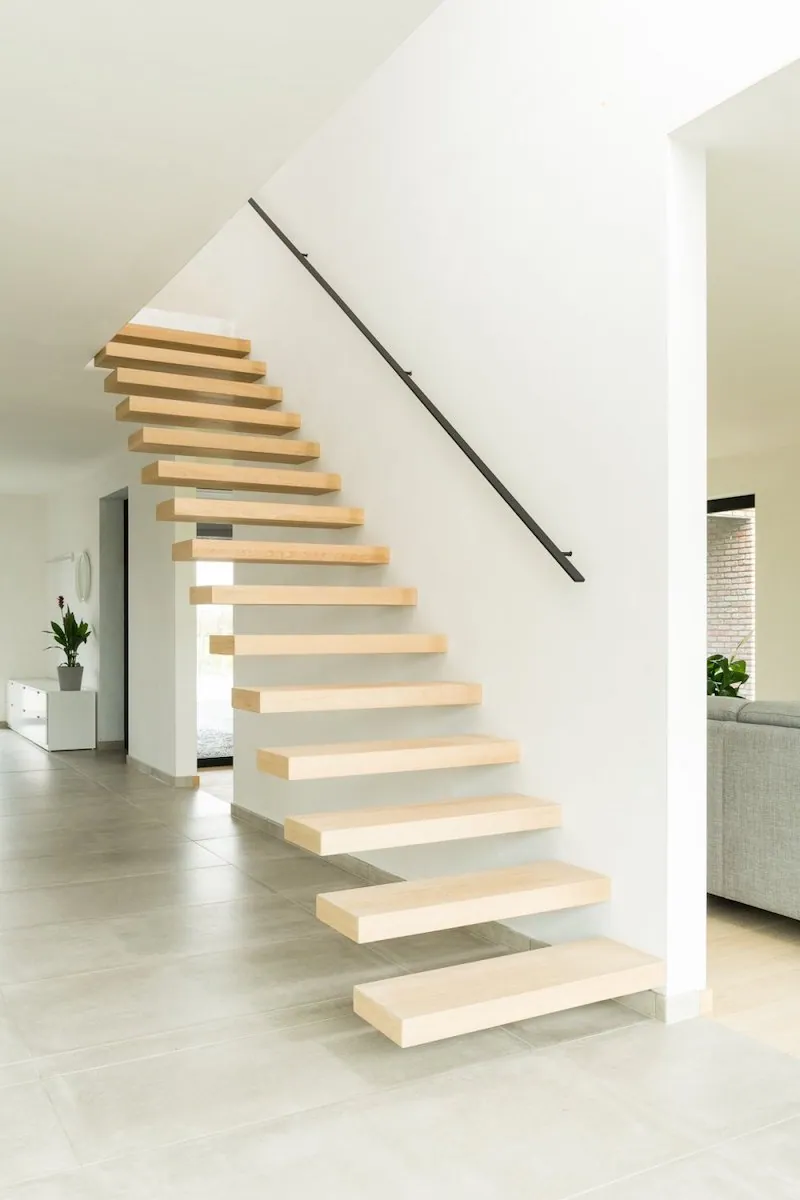
The colour is pale, slightly cream, with little visible grain. Some find it too neutral; others appreciate precisely that discretion, which leaves all the space to the rest of the room. The hardness is adequate for residential use, lower than oak but sufficient with regular upkeep. Rubberwood takes stain well: it can take darker tones that move it away from its natural appearance and bring it visually closer to light oak or a more exotic timber.
We recommend it for straight or gently L-shaped staircases, in homes with normal foot traffic and attentive maintenance. It is not the timber for a busy spiral staircase in a large family home, but it is an honest choice for someone who wants a handsome result at a reasonable cost.
« The wood you choose for your staircase, you will touch it every day. It should speak to you from the very first glance. »
Oil or lacquer: the finishing question
The choice of timber cannot be separated from the surface treatment. For staircases we work mainly with two finishes:
- Hard oil or wax penetrates the fibre without building a film. It gives a natural matt or satin look, allows local repairs and lets the grain show through. It requires periodic maintenance, once a year or every two years depending on traffic, but that upkeep is simple and done by hand.
- Lacquer forms a protective film on the surface. It is more resistant to water and point impacts, but a deep scratch is harder to repair locally. Satin lacquer is our choice when the client prefers minimal day-to-day maintenance.
On rubberwood as on oak, the oil can be pigmented to shift the colour noticeably. Natural oak can take a heavily smoked tone without losing its material legibility. Rubberwood can be oiled in ash grey or warm brown depending on the atmosphere sought.
What we look at before choosing
When you come to see us about a staircase, we always ask the same questions before settling on a species:
- What is the ground-floor covering? An oiled oak parquet often argues for continuity. Large-format tiles tolerate a contrasting choice more easily.
- How much light does the stairwell receive? Walnut too dark in a hallway without a window can weigh the whole down. Pale rubberwood can open the space instead.
- How many people use the staircase daily, and in what kind of footwear? A staircase that sees heavy daily use needs a harder species and a resistant finish.
- What is the life horizon in this home? An oak staircase belongs to a long-term project; rubberwood can suit an interim renovation.
Only after that conversation do we show you the samples, ideally in the light of your home or in our Beersel showroom. Wood is chosen in person, not on a screen.